
Surprise, surprise

Times Higher Educational Supplement logo

Tara Brabazon in the Times Higher Education Supplement when discussing coursework masters degree courses:

“They are squeezed between the crowd control of undergraduate education and the over-bureaucratised doctoral programmes that dislodge the historically functional relationship between a PhD candidate and supervisor.”

She draws attention to the remarkable creativity of her students, when unleashed with a little flexibility:

“Although there is a science – and craft – to curriculum, we never know how our students will remix our aims and riff off our structure to create melodies and syncopations beyond our lesson plans.”

I know what she’s talking about and we have designed this thinking in to our new degree framework for batchelors, masters and doctorate at the University of Bolton.

Although her article is flowery in its language and this begins to grate as I get to the end, the sentiments and concepts are important:

“These students want a second chance to remake their careers and lives. Their enthusiasm is contagious, and their examples show that change and creativity emerges when courageous students decide to live their lives differently.”

Our take on this fertile opportunity is Inter-disciplinary inquiry-based learning founded in an action research philosophy.

At this point in her article, Tara switches to talking about the link between research and teaching, through the students’ inquiry referencing the HEA report Linking Teaching and Research in Disciplines and Departments.

My worry is that this paper, and her language, are not radical enough in conceiving students as co-researchers in the 21st century. Surely now, ivory-tower academic authority is no longer seen as the know-it-all top of the pyramid (to mix a few metaphors myself), but still has a vital role to play in gathering the best, modelling excellence and rigour and wisely critiquing and deferring to the evidence base from professional practice.

Tara pleas:

“I hope that through the stress and the marking, the stress and the moderation, the stress and the exam boards, academics feel buoyant at their teaching achievements but humbly reflective about what our students can teach us.”

Agreed, and I suggest we should focus on how to make these important teaching acts as delightful and stress free as possible.
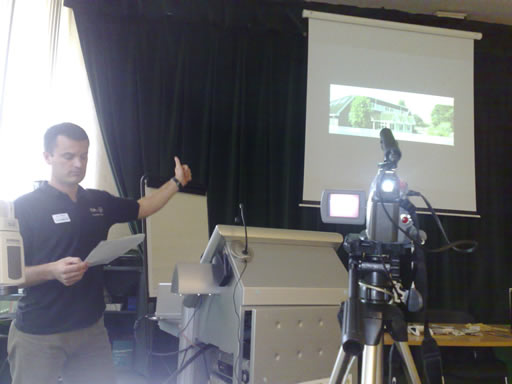
TeachMeet Redbridge (part 2)

TeachMeet 7

My first post about TeachMeet was a hurried blog in case Ewan offered a prize for the first person to Blog the event!

More reflection, and waiting until the end, allows a more thoughtful blog which fills in some of the blanks.

Blank 1 – why speak about delight?

It was delightful to be able to speak about delight, and to discuss with colleagues in the breaks to ‘orient’ my thinking about this important topic.

I failed to say that I care to make an analysis of delight for many reasons:

  1. I feel the need to put some intellectual effort into a mantra, ‘delight is important in learning’, which I have been chanting uncritically for over fifteen years.
  2. I believe delight is one of the sources of motivation, perseverance and retention which softens the pain of the ‘hard yards’ in learning.
  3. I believe delight (and more generally fulfilment) is an entitlement for learners, as they learn, not when they pass exams.

Blank 2 – what a stonking set of presentations!

I failed to mention the wealth of speakers and the high quality of their ideas and practices on parade. Egocentrically, and only after Drew Buddie had pointed it out, I was struck by the chickens coming home to roost from Ultralab‘s and Apple Teacher Institute work in the early ‘noughties’, such as movie making and stop-motion animations around social and serious issues. More moving were the confident presentations from folk like Sarah Hackett on using Moodle to teach folk fiddle and Tom Whitehead on animal shape poetry workshops, both researchers from Ultraversity, these along with many others were inspiring.

Blank 3 – FlashMeeting

I had volunteered to be the meeting end of an online video-conference for those who couldn’t be arsed couldn’t get to Redbridge. 🙂 Thanks to David Noble, Anthony Evans and Nic Hughes for making it all so easy. It seemed to work well, using FlashMeeting and connecting my Apple MacBook Pro to a Canon digital video camera with a firewire cable and using a directional microphone to get the best quality – I rely on reports from participants as to whether this was effective and I apologise now for the time through the break when I went to get a beer and got cornered in the bar – I came back to find the camera pointing at the ceiling! I only regret not carrying through my original plan to use a second data projector so that the audience in the building could see the participants out there and perhaps respond to their questions and comments. Next time.

An Analysis of Delight

Delight

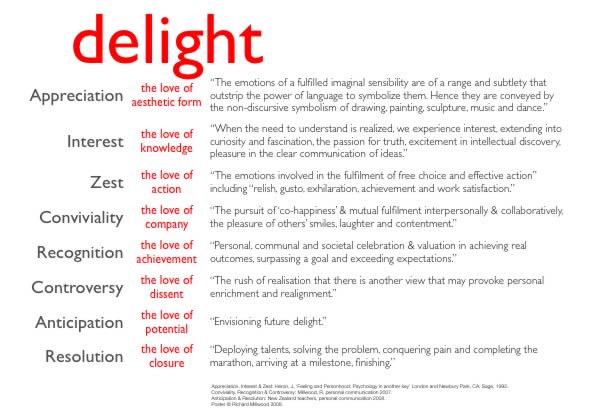
Ever since reading about John Heron’s ‘up-hierarchy’ of delight, with his wonderfully expressive language, I have been enjoying adding new elements (although disregarding for now their connection, except as a list). I have made a poster of them and will be talking about them (if chosen to speak) at the TeachMeet in Redbridge on Monday 19th May.

The idea is that they are a source of explanation and stimulus for designing delight into teaching & learning.

Why do we like playing games on the computer? – perhaps because high quality and visually seductive graphics offer ‘appreciation’ and the many choices and their consequences feed ‘zest’.

Why do we like learning together? – perhaps because we get ‘conviviality’, ‘recognition’ and ‘controversy’.

Why do we persist when learning is tough? – perhaps because there is ‘interest’, ‘recognition’ and ‘resolution.

Is this all too obvious? Or do you, like me, want to put this poster on your wall to keep it fresh in your mind?

Creative Commons License
An analysis of delight by Richard Millwood is licensed under a Creative Commons Attribution-Share Alike 2.0 UK: England & Wales License.
Based on a work at blog.richardmillwood.net.An Analysis of Delight

A University for Improvement

IDIBL logo

Almost five years to the day that Ultraversity was validated at Anglia Ruskin University, we have received conditional approval for a new scheme based on the same philosophies of learner-centred, work-focussed, community-supported, action-inquiry and innovative assessment.

This IDIBL course framework validated at the University of Bolton is more ambitious in scope, more refined in character and draws fresh inspiration from the organisational thinking from its home in the Institute for Educational Cybernetics.

We can now begin to recruit in earnest for a Masters course in ‘Learning with Technology’ and follow it up with further courses in Regeneration & Sustainable Communities, Chronic Healthcare and other societal thematic problems which need active and vibrant attention.

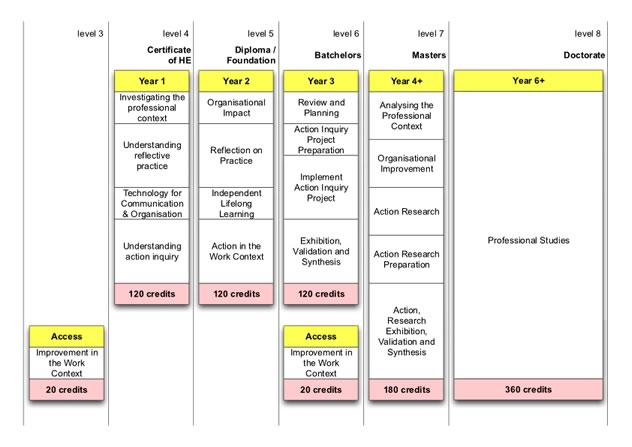
In each case the proposals will be relatively cost-effective to approve by basing their pedagogy and organisation on our IDIBL framework:IDIBL framework